EDI for Shopify: connect retailer purchase orders to your store
Shopify has no built-in EDI. Here's how retailer 850 purchase orders can become Shopify orders, with 856s and 810s sent back on fulfilment: interSend's coming connector.
· 7 min read
On this page
- Does Shopify support EDI?
- Which EDI documents will a retailer ask for?
- How interSend's Shopify connector will work (planned)
- Purchase orders become real Shopify orders
- Fulfil with tracking, and the ship notice goes out
- Stock feeds read Shopify inventory
- Retailers and marketplaces it is built for
- Shopify B2B and retail EDI are different things
- What the first version won't do
- How to choose a Shopify EDI provider
- FAQ
- Does Shopify support EDI natively?
- Will EDI orders send emails to the retailer's customer?
- Will EDI orders change my Shopify stock?
- When is the 856 ship notice sent?
- Can I sell to retailers that use SPS Commerce?
- Can one Shopify store handle several retailers?
- Is interSend's Shopify connector available now?
- How do I get early access?
- Get ready for retail on Shopify
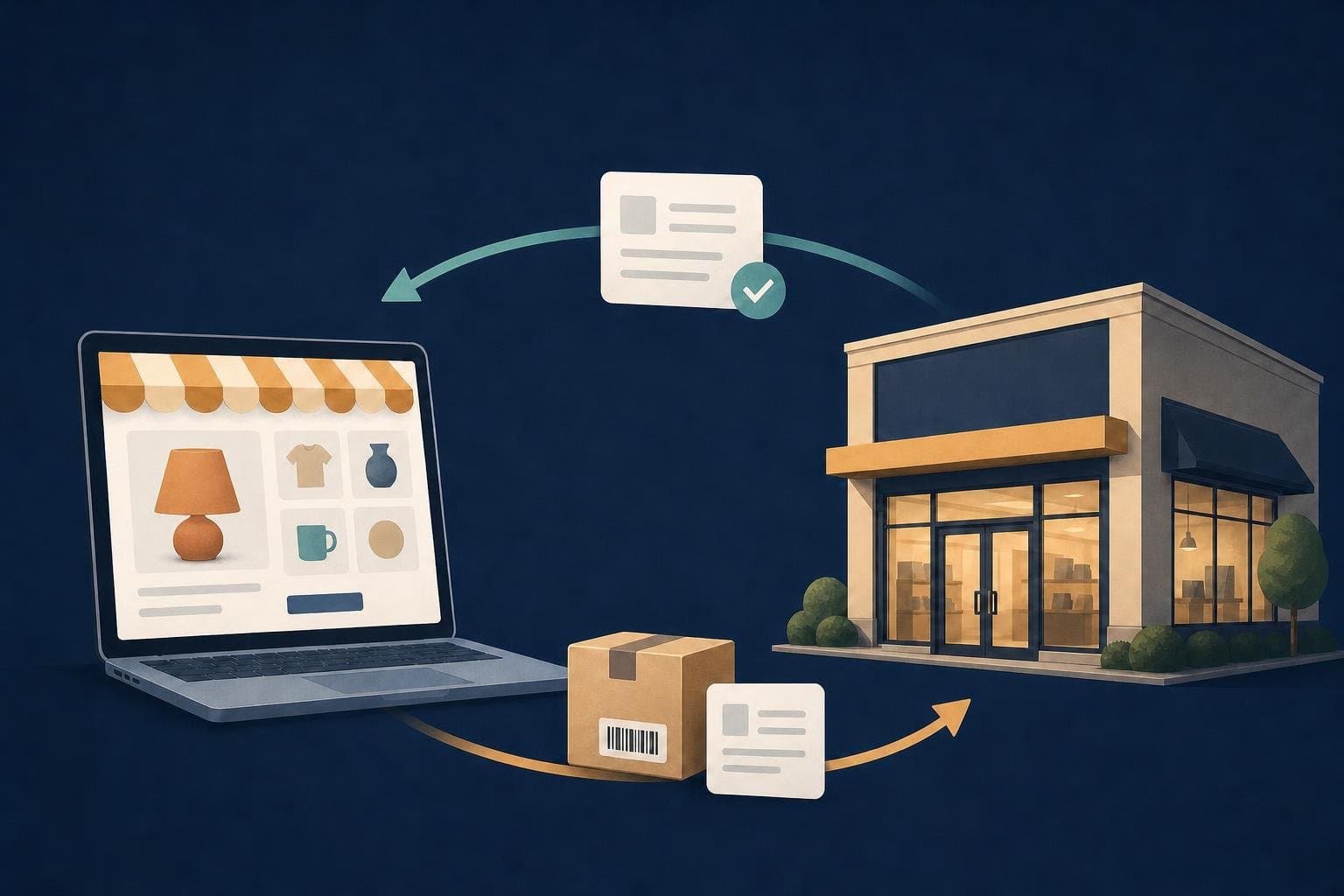
Shopify EDI integration means connecting a retailer's EDI documents to your Shopify store: their purchase orders (850s) become Shopify orders, and your ship notices (856s), invoices (810s) and stock (846s) go back to them. Shopify has no built-in EDI, so it takes an app. interSend already does this for brands on Sellercloud today; its Shopify connector is in development.
Last updated: November 2026.
Does Shopify support EDI?
Not on its own. Shopify works through APIs, not EDI files, so a store cannot read a retailer's X12 purchase order or send back a ship notice without an app in between. That app has to speak both languages: EDI files exchanged with the retailer (usually over SFTP, or through a network such as SPS Commerce) on one side, and Shopify's GraphQL Admin API on the other.
You do not need Shopify Plus for this in principle: it depends on how the app connects. interSend's connector is planned as a Shopify app installed on your store.
Which EDI documents will a retailer ask for?
| Document | Plain name | Direction |
|---|---|---|
| 850 | Purchase order | Retailer → you |
| 997 | Functional acknowledgment ("we received your file") | Both ways |
| 855 | Purchase order acknowledgment ("we accept the order") | You → retailer |
| 856 | Advance ship notice (ASN) | You → retailer |
| 810 | Invoice | You → retailer |
| 846 | Inventory advice (stock levels) | You → retailer |
Most retailers use the X12 standard. Each has its own rules on top: file names, which IDs to use, when each file is due. A connection built for one retailer rarely works for the next without changes. Our post on EDI setup and testing explains the documents in more depth, and EDI 856 and 997 explained covers the ship notice and the acknowledgment that most often cause trouble.
How interSend's Shopify connector will work (planned)
| EDI document | What happens in Shopify |
|---|---|
| 850 purchase order | A Shopify order is created with the retailer's PO number, items, prices and ship-to address, tagged with the partner |
| 855 acknowledgment | Sent once the order exists in Shopify, for partners that want one |
| 856 ship notice | Sent when the order is fulfilled in Shopify with tracking |
| 810 invoice | Sent with the shipment, for EDI partners |
| 846 stock | Built from your Shopify inventory on a schedule |
Purchase orders become real Shopify orders
The plan is to create each partner order as a normal Shopify order rather than a draft, so it takes exactly the prices and lines the retailer sent. Each order is designed to carry:
- the retailer's PO number and its own order number, so you can search for it;
- tags naming interSend and the partner, so you can filter partner orders or route them with your own rules;
- the partner's ship method as the shipping line;
- no customer emails: Shopify's receipts are turned off, because retailers and marketplaces do not allow their customers to be emailed by the supplier;
- stock committed, so your inventory and the next stock feed stay right.
Each line is matched to a Shopify variant by SKU. If a SKU is missing in Shopify, or matches two variants, the order is not created and you are told which SKU, rather than an order going in with a line missing.
Fulfil with tracking, and the ship notice goes out
Your warehouse fulfils the order in Shopify as usual and adds tracking. interSend reads the fulfilment and sends the retailer its ship notice and, for EDI partners, the invoice. Shopify's carrier names (UPS, FedEx, USPS and so on) are mapped to the codes each retailer expects, using the same carrier map interSend uses today. Each tracking number becomes a package on the ship notice.
Stock feeds read Shopify inventory
On each connection's schedule, interSend reads available quantities from Shopify, after any stock you hold back, and sends them to the retailer. You will be able to choose which Shopify location feeds a partner. The same safety check as today applies: a feed that would suddenly tell a retailer everything is out of stock is held, not sent, and you are alerted.
Retailers and marketplaces it is built for
The Shopify connector reuses interSend's existing partner connections, which work with Sellercloud today:
- Rooms To Go, through SPS Commerce: Rooms To Go integration. For the details, read Rooms To Go EDI with Sellercloud and the TSCA statement on Rooms To Go invoices.
- ShopHQ, through Radial: ShopHQ integration, with more in ShopHQ drop ship EDI with Sellercloud.
- Any other X12 EDI partner over SFTP: EDI partners
- Wayfair, through its supplier API: Wayfair and Sellercloud
- Secret Sales, through its marketplace API: Secret Sales integration, with more in Secret Sales and Sellercloud.
The retailer sees no difference: the same files, in the same format, whether your orders live in Sellercloud or Shopify.
Shopify B2B and retail EDI are different things
Shopify's own B2B features let wholesale buyers order from you on a storefront, with company accounts and price lists. Retail EDI is the opposite direction: the retailer's system sends you purchase orders as files, and expects files back. Big-box and furniture retailers, and most drop-ship programmes, use EDI. If a retailer's vendor guide mentions 850s and 856s, you need EDI, not B2B.
What the first version won't do
Some details are still being decided, such as whether partner orders read as paid or payment pending in Shopify, and whether a retailer's cancellation should cancel the Shopify order. We will update this post when they are settled.
How to choose a Shopify EDI provider
Whichever app you choose, ask:
- Which documents are included, and is there a charge per document or per character?
- What does each extra retailer cost, and is there a setup fee per retailer?
- Who does the certification testing with the retailer, and how long does it usually take?
- Real orders or drafts? Drafts need someone to approve every order.
- Do you need Shopify Plus?
- What happens when something fails? Look for plain alerts, a log of every file, and a way to send a file again.
- Is there a contract, and what does it take to cancel?
FAQ
Does Shopify support EDI natively?
No. Shopify exchanges data through APIs. An app translates between the retailer's EDI files and your store.
Will EDI orders send emails to the retailer's customer?
interSend's connector is designed never to: Shopify's order and shipping receipts are turned off for partner orders.
Will EDI orders change my Shopify stock?
Yes, by design. Each partner order commits stock in Shopify, so your inventory and the next stock feed stay accurate.
When is the 856 ship notice sent?
After the order is fulfilled in Shopify with a tracking number. Without tracking, nothing is sent. EDI 856 and 997 explained covers what goes in it.
Can I sell to retailers that use SPS Commerce?
Yes, when the retailer's setup lets you exchange files in the folders SPS collects from, as Rooms To Go's does. interSend works with those files directly.
Can one Shopify store handle several retailers?
Yes. Each retailer is its own connection, and one store can serve them all.
Is interSend's Shopify connector available now?
Not yet; it is in development. The same connections are live for Sellercloud today.
How do I get early access?
Book a call and tell us which retailers you sell to. We will tell you where the connector stands and what you would need to have ready.
Get ready for retail on Shopify
If a retailer has just sent you an EDI spec, the files and rules will not change when the Shopify connector arrives: getting your SKUs, UPCs and carrier details in order now is time well spent. To talk it through, book a setup call with Stronger eCommerce.
About the author
Connect your retail partners to Sellercloud with interSend
Orders in; ship notices, invoices and stock out, with plain-English alerts when something needs you. It starts paused, and nothing is sent until you switch it on.
Book a setup call (opens in a new tab)On the call we create your company's account with you and get your first partner live. You then choose a plan in the app, which starts the free trial.
Keep reading

Emma· · 3 min read
ShopHQ drop ship EDI with Sellercloud: orders, Radial codes and packing slips
How ShopHQ drop ship vendors on Sellercloud handle EDI through Radial's VendorNet: orders in, ship notices with Radial's codes, invoices, stock and ShopHQ-style packing slips.
shophqradialedidrop shipsellercloud

Emma· · 4 min read
Rooms To Go EDI with Sellercloud: what SPS Commerce expects and how to get certified
A furniture supplier's guide to Rooms To Go EDI through SPS Commerce: the six documents, what makes their spec different, and testing in SPS's folders before going live from Sellercloud.
rooms to goedisps commercesellercloud
Jay· · 5 min read
An EDI order failed in Sellercloud. Now what?
A short, repeatable routine for the day an 850 doesn't land in Sellercloud or an 856 bounces: find it, see what the partner actually sent, fix the one thing that's wrong, and re-run it.
edisellercloudtroubleshootingintersend